Your cart is currently empty!

Textile designs – what they are and how they are created
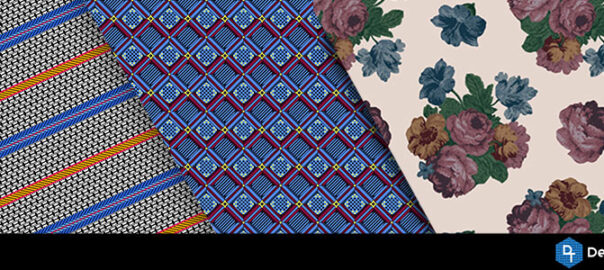
Textile designs are designs specifically designed to be used to make fabrics.
The textile designs can have an infinity of different patterns, even if some basic technical and stylistic rules are always to be taken into account, and one of the most important is repeatability.Repeatability is the characteristic of a pattern to be repeated several times both in X and Y direction, without creating unsightly stripe or strikethrough effects when the pattern will be repeated several times on the entire surface of a fabric.
There are two application methods to give a fabric a well-defined design, whether it is a set of flowers, geometric patterns, patterns or other.
Print:
It is the “simplest” method and conceptually it is as if you were printing any graphic image on a sheet of paper.
It starts with a drawing made by computer, (in the past on paper), usually made by a textile designer, and then printed on fabric.
Logically, even if the technique is similar, in practice you have to use special techniques and machinery for fabrics that today are basically like large computer printers, and that have evolved over time like any type of electrical/electronic equipment.This first method, we can consider it the “simplest” method to transfer a design onto a fabric, but it is also the least valuable. This depends on the fact that the design is generally printed on fabrics with simple weave and quite “flat”, and even the design consequently does not take any particular three-dimensionality, remaining very flat as if it were printed on a sheet of paper.
This technique is often used for clothing fabrics such as t-shirts, skirts, pants. This method is very often used on cheap fabrics because it has quite “low” costs for printing.
Jacquard:
This method is much more complex and technically very difficult. To be learned there is a need for special technical and not only stylistic study.
Generally to realize a Jacquard design to the end you need two types of experts, the textile designer and the textile technician, the first to realize the pattern, the second to transform it into a design suitable to be fabric.
In some cases the textile designer and the textile technician can be the same person, but after a lot of work experience, otherwise they are different people.To fully realize a Jacquard design since a long time we use special software (CAD) dedicated to the world of weaving.
With the Jacquard system the pattern is “brought” on the fabric directly during the loom weaving, thanks to the weaving of threads (y) and wefts (x), with different colors of the various wefts and/or threads, and the particular and different type of weaving.
This method makes the pattern on the fabric part of it and indelible for life, unless the fabric breaks. It also gives the fabric exceptional visual characteristics such as three-dimensionality, more valuable appearance, and strong visual impact.
This technique is used for various types of fabrics, both for clothing and furniture. Some examples are, ties, scarves, carpets, fabrics to cover sofas, chairs, and much more.
This type of fabric is also used to make valuable textiles due to its special characteristics, and logically in proportion is more expensive than fabrics designed by printing method.“Designs for Textiles” creates textile designs suitable for both printing and Jacquard method, but always using the refined and special techniques for Jacquard fabrics, for the highest quality and value of the final product.
Look our textile designs HERE